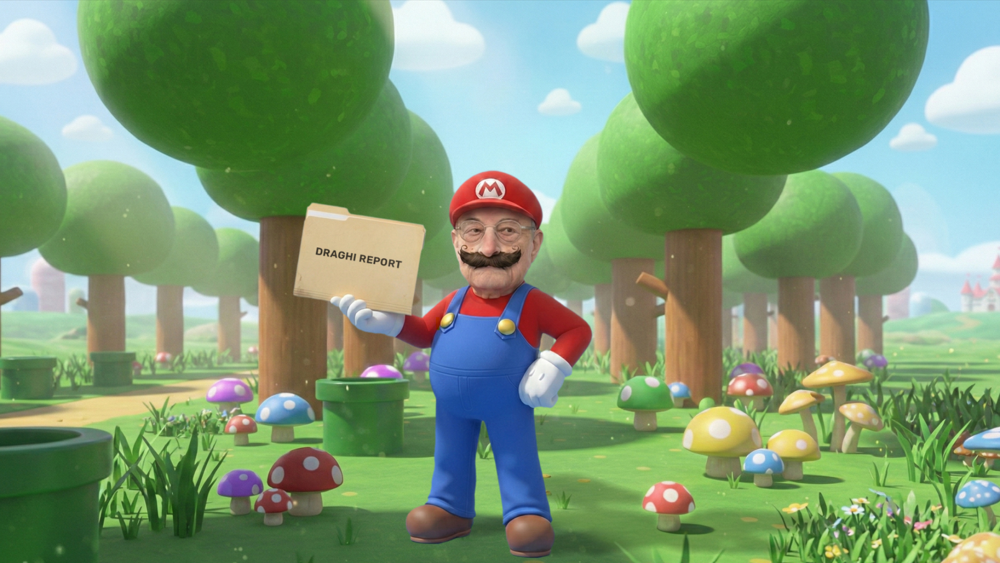
The European Union is sleepwalking into economic irrelevance, and its political elite are misdiagnosing the disease. Behind the choreographed unity and hollow rhetoric of recent summits, the EU is paralysed by a profound, three-decade-long structural productivity crisis. The narrative that Europe merely suffers from a ‘competitiveness problem’ that can be fixed with protectionist ‘Buy European’ clauses and minor bureaucratic tweaking is a fatal delusion.
Productivity problem
Hard data reveals a continent in decline. Labour productivity growth – the ultimate engine of societal prosperity – has flatlined across the continent. In the early 1970s, Western European economies enjoyed robust annual productivity growth of over five per cent; today, growth in the EU-27 has plummeted below 0.5 per cent. The reality in major Western member states is even more grim: between 2000 and 2023, productivity per hour worked completely stagnated in Italy and, since 2020, productivity in France has actually declined by 0.1 per cent.
The False Cure: Draghi- inspired industrial policy
The EU’s flagship responses – Mario Draghi’s landmark report, the Commission’s ‘Competitiveness Compass’, omnibus ‘simplification’ packages, etc – are destined to fail because they double down on the policies that caused the crisis.
Rather than tackling the root causes, Draghi proposes a centrally planned €800 billion investment bonanza, including enormous subsidies mostly under the guise of a ‘clean- tech’ transition. This massive state intervention aims to compensate for competitive weakness by propping up uncompetitive firms. To make this mobilised private capital profitable, governments would need to artificially slash the cost of capital by 2.5 per cent through taxpayer-funded financial incentives. This is a subsidy drive to make up for the failures of fundamental economic reform.
The real root causes of Europe’s paralysis
Europe’s crisis is not due to a lack of state intervention, but rather an ideology of anti-growth and a pervasive culture of dependency.
- An investment collapse: Net corporate investment rates have collapsed from the highs of the 1960s to a stagnant two to three per cent of GDP following the 2008 financial crisis. Rather than investing in physical automation and trans formative technology, companies have relied on cheap, low-wage migration to maintain margins without improving processes.
- The deindustrialising Green Deal: The EU’s climate policy is driving devastating energy costs. Because of the forced transition away from fossil fuels to volatile renewable energy, industrial electricity prices in Europe are two to three times higher than in the US. This penalises any company attempting to introduce energy-intensive, productivity-boosting technologies like AI and advanced automation.
- The precautionary stranglehold: Driven by a risk-averse technocracy, the EU’s adherence to the ‘precautionary principle’ prioritises banning potential risks over embracing disruptive innovation. Heavy-handed regulations, such as the AI Act and bans on green genetic engineering, inherently protect established global monopolies while blocking the market entry of dynamic new challengers.
- The migration fallacy: For years, European economies have been propped up by cheap labour via migration. But not only have successive waves of migration been less economically beneficial, the very addiction to low-wage migration has reduced productivity in itself. If labour is cheap, companies do not invest in productive changes or automations.
The verdict
The European Union cannot regulate, subsidise or protect its way to prosperity. To genuinely revive its economy, Brussels must embrace the painful but necessary process of ‘creative destruction’ – allowing uncompetitive zombie companies to fail so that innovative ones can thrive. Unless the EU unwinds its anti-growth climate policies, abolishes protectionist non-tariff barriers, ends cheap money subsidies, and dismantles its innovation-choking regulatory tsunami, the current competitiveness agenda will amount to nothing more than managing Europe’s own relative decline.